


Reach Professional-Grade ANSYS Fluent Training Course — Ep 09
Heat Transfer: Towel Warmer
- Lesson
- 09
- Run Time
- 12m 54s
- Published
- Jun 24, 2026
- Category
- ANSYS Fluent
- Course Progress
- 0%
Towel Warmer Heat Transfer (Conjugate Heat Transfer) — ANSYS Fluent CFD Simulation
A towel warmer is a heated rail mounted in a bathroom that warms and dries towels while adding gentle background heat to the room. Although it's an everyday appliance, simulating it well is a genuine multimode heat-transfer problem: heat conducts through the solid heating elements, drives buoyancy-driven natural convection in the surrounding air, and radiates to the nearby walls and towels — all three modes acting at once. This project uses ANSYS Fluent to model that coupled behavior, capturing how heat spreads from the warmer into the towels and the enclosed bathroom space, and where the design heats evenly versus where it leaves cold spots.
The geometry is the towel warmer within its enclosed bathroom-like air domain, set up in Design Modeler and meshed in ANSYS Meshing, with the mesh resolving both the solid (heating element and structure) and the surrounding fluid region so the conjugate heat transfer can be captured across the solid–fluid interface.
The simulation couples three heat-transfer mechanisms. Conduction is solved through the heating elements and warmer structure; natural convection is modeled as buoyancy-driven flow, where temperature differences set the air in motion and circulate heat around the warmer; and a radiation model accounts for radiative exchange between the warmer surface and the surrounding walls and towels — important in an enclosed space where radiation contributes meaningfully to the warming effect. Because the airflow is low-speed and buoyancy-driven, the turbulence treatment is chosen to suit natural convection rather than forced flow. The heating element is driven by a defined power or surface temperature, with ambient room conditions and material properties applied to the air and towels.
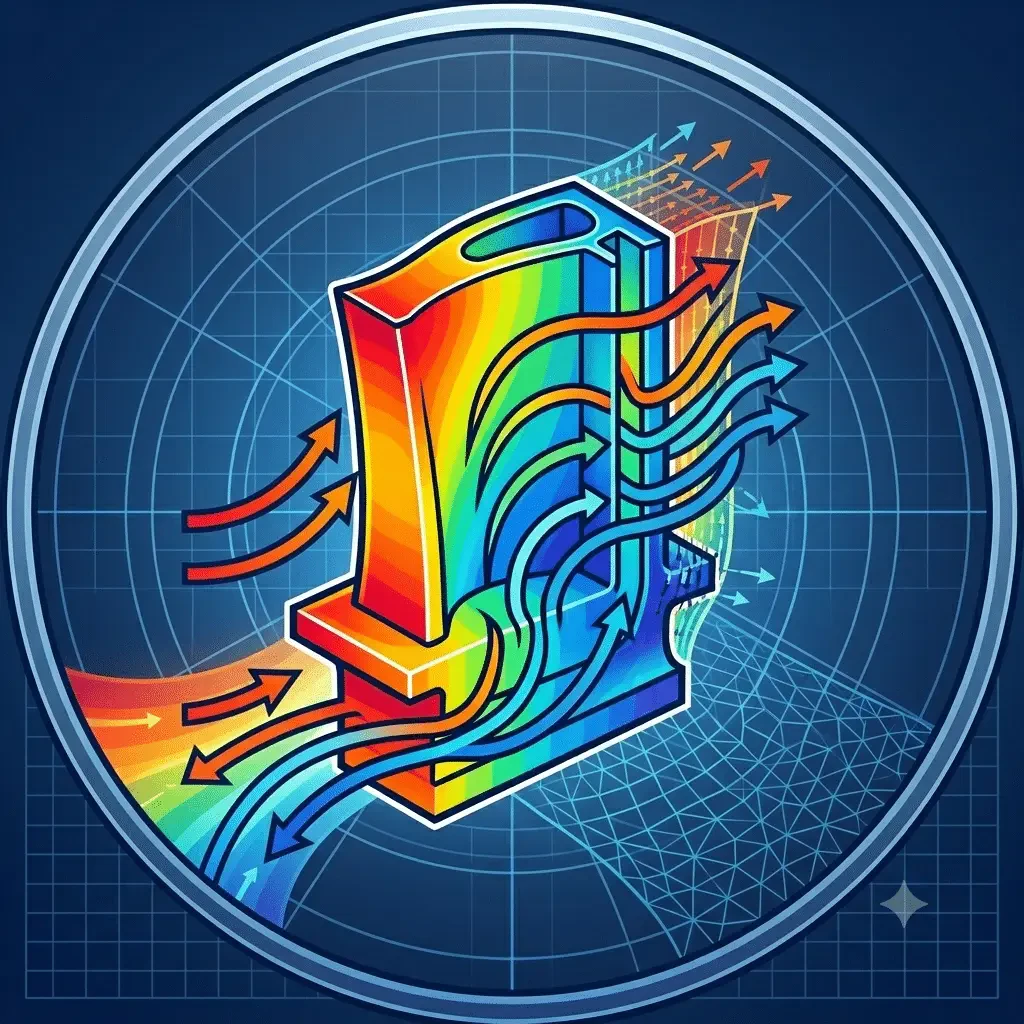
At the end of the solution, you generate temperature contours across the warmer and the room, plus velocity vectors and pathlines that reveal the buoyancy-driven air-circulation pattern. From these you can assess how uniform the surface temperature is, estimate the heat-transfer rate from the warmer to the towels, and identify cold spots — regions of inefficient heating that point to design improvements. By the end of this project, you'll be able to set up a conjugate heat-transfer simulation that couples conduction, natural convection, and radiation in an enclosed space, select appropriate turbulence and radiation models for low-speed buoyancy-driven flow, and interpret the results to evaluate heating uniformity and energy efficiency in a household appliance.