


Reach Professional-Grade ANSYS Fluent Training Course — Ep 13
Mechanical: Intake of a Jet Engine
- Lesson
- 13
- Run Time
- 8m 27s
- Published
- Jun 24, 2026
- Category
- ANSYS Fluent
- Course Progress
- 0%
Jet Engine Intake (3-D Internal Aerodynamics) — ANSYS Fluent CFD Simulation
The intake is the first component of a jet engine, and its job is deceptively difficult: it has to deliver air to the engine face smoothly, with as little pressure loss and as much uniformity as possible, across a wide range of flight conditions. Poor intake performance — distorted or non-uniform flow reaching the compressor — directly degrades engine efficiency and can threaten stable operation. This project uses ANSYS Fluent to simulate the airflow through a jet engine intake, examining the pressure and velocity fields inside the duct and the uniformity of the flow arriving at the engine face.
The simulation works from a 3-D intake geometry imported as a prepared mesh, so the focus stays on the flow physics and solver setup rather than geometry creation. Boundary conditions are configured to represent the operating conditions a jet engine intake experiences — an incoming air stream at the intake entrance and the engine face as the downstream boundary — and the case is run to convergence to resolve how the air accelerates, turns, and redistributes as it moves through the duct.
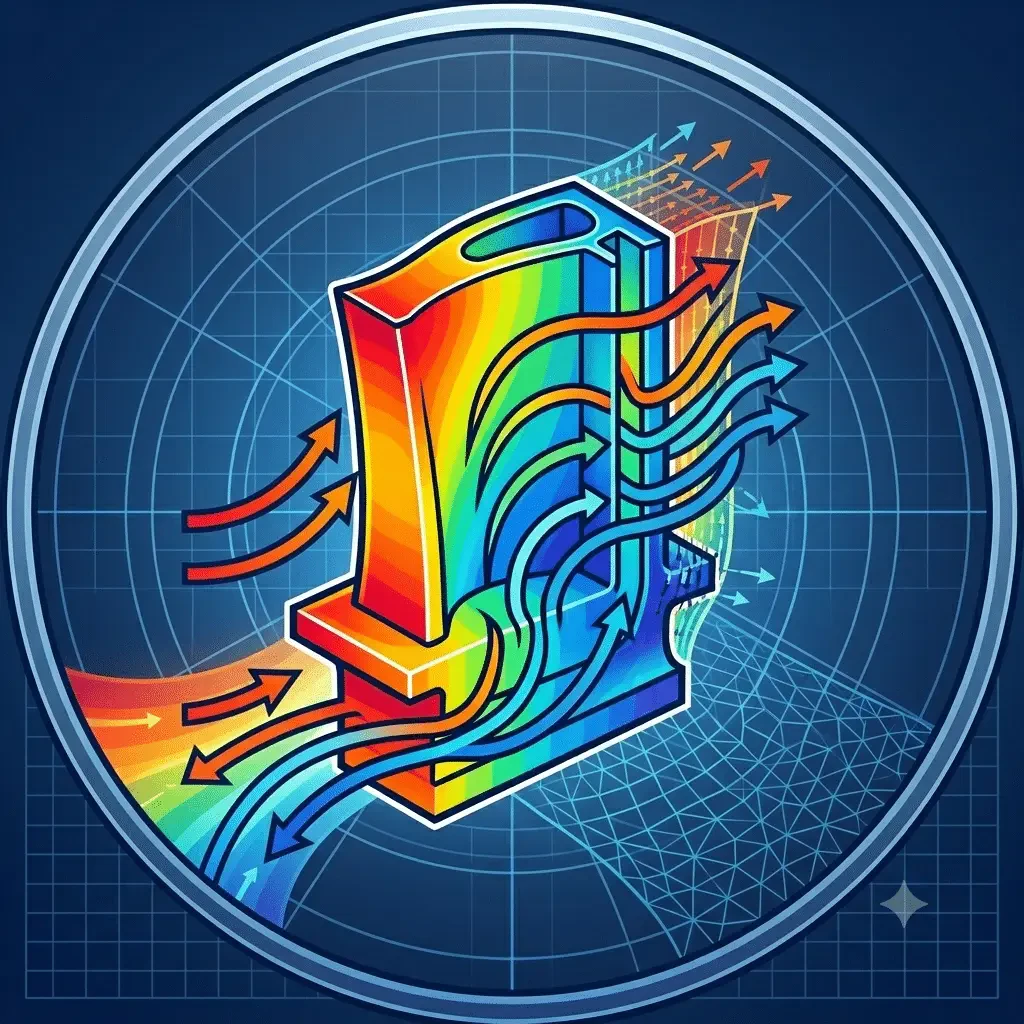
At the end of the solution, you generate pressure and velocity contours through the intake, along with flow visualizations that reveal how the air interacts with the intake geometry. From these you can assess two things that matter most for intake performance: the pressure and velocity distribution along the duct, and the flow uniformity at the engine face — the degree to which the air arriving at the compressor is even rather than distorted. By the end of this project, you'll be able to set up and run a 3-D internal-aerodynamics simulation from an imported mesh, apply realistic intake boundary conditions, and post-process the results to evaluate pressure recovery and flow uniformity — the core metrics that drive intake design decisions in aerospace engineering.