

MR CFD’s All Courses
Here's every Course from Basic to Advanced, that can boost your skills and career.

Price: $140
This project simulates blood flow in a porous artery wall using CFD in ANSYS. The wall is modeled as a high-viscosity fluid to mimic porosity, with no actual flow through it. Geometry was simplified, meshed, and solved in Fluent under steady laminar conditions. The study includes validation, mesh independence, and analysis of velocity profiles.

Price: $270
This artery flow project involves the simulation of blood flow in a compliant artery using CFD and FSI techniques in ANSYS. The primary objectives are to validate the simulation against a published study, analyze mesh independence, and investigate the effects of wall compliance and porosity on hemodynamic behavior. The artery geometry is simplified and reconstructed for numerical accuracy, with meshing performed in ANSYS Meshing and flow solved using Fluent. Wall deformation is modeled using the FSI module, while porosity effects are simulated by assigning high-viscosity fluid properties to the vessel wall. Simulations are performed under unsteady, incompressible flow conditions with non-Newtonian blood properties. Key results include time-dependent deformation, wall shear stress, and velocity distributions, with validation confirming a shear stress error below 1% in mesh studies.
Price: $420
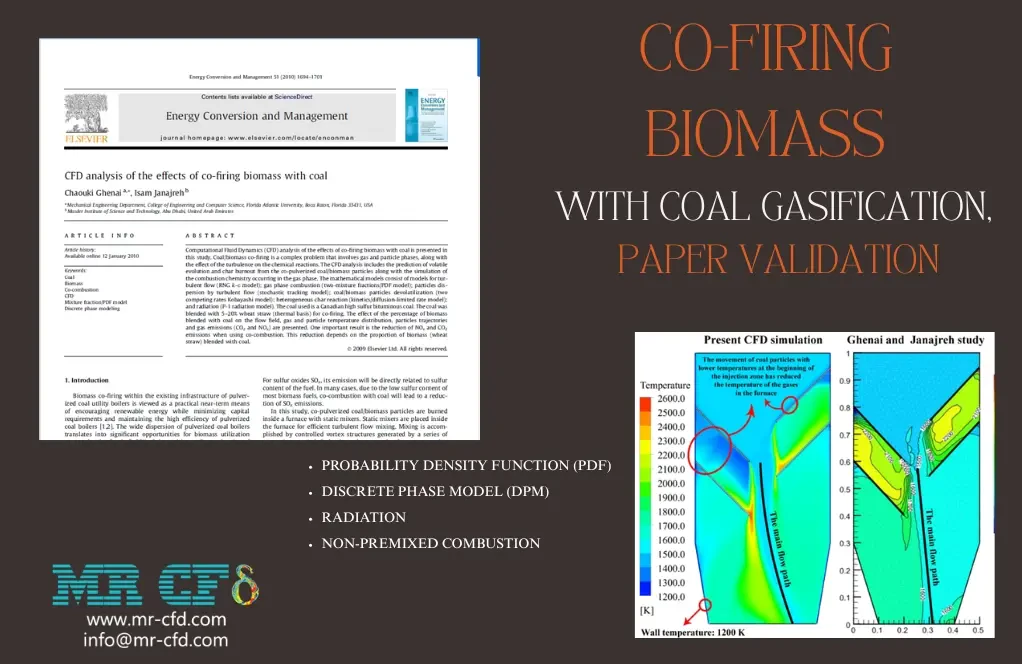
Co-firing Biomass with Coal Gasification. This project involves the simulation of coal and biomass co-firing in a furnace using CFD techniques. The primary objectives are to examine the combustion characteristics and validate the simulation results against the study by Ghenai and Janajreh. The furnace is defined with specific boundary conditions, and simulations are performed using an unsteady, incompressible flow model. The turbulent flow within the furnace is modeled using the k-e RNG turbulent model, thermal radiation is simulated with the P1 model, and combustion is analyzed with a PDF model. The simulation incorporates the kinetics/diffusion-limited rate model for particle combustion and the two competing rates Kobayashi model for devolatilization. Results are compared in terms of temperature contours and particle trajectories, confirming the simulation’s accuracy with a maximum error of approximately 5% in particle temperature ranges.
Price: $240
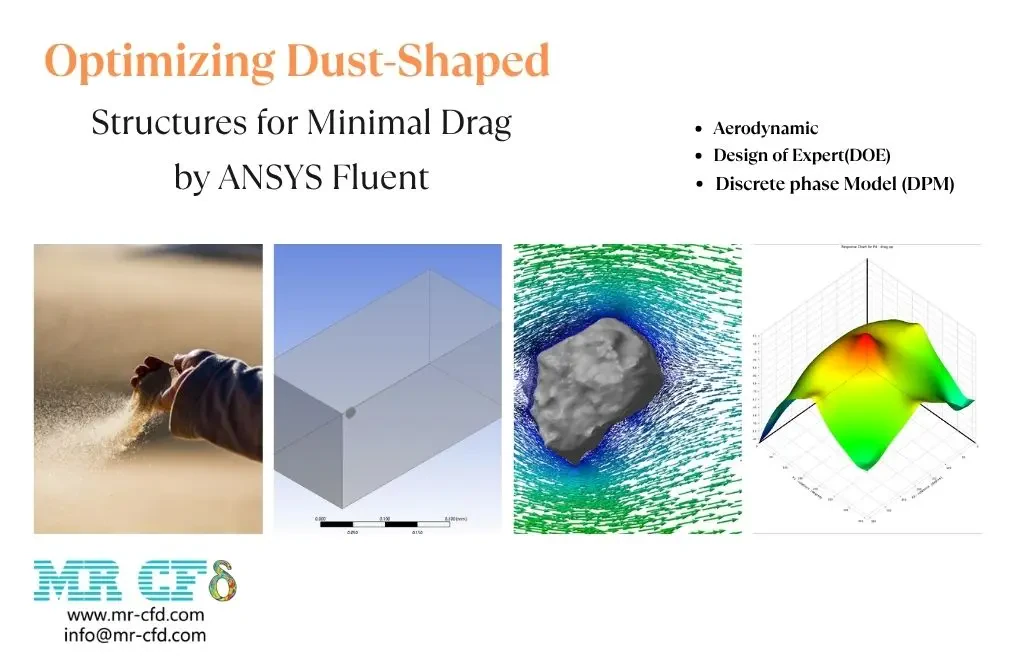
This project simulates and analyzes a dust-shaped geometry exposed to wind using Computational Fluid Dynamics (CFD). The study employs a pressure-based solver with a focus on understanding drag forces resulting from varying inlet velocities and rotational dynamics. The study uses advanced optimization techniques, including Design of Experiment (DOE) and Central Composite Design (CCD) methods, to explore 15 design scenarios. The findings highlight the inlet velocity magnitude as the most influential parameter, aiding in the optimization of aerodynamic efficiency and contributing to enhanced dust simulation accuracy.
Price: $48
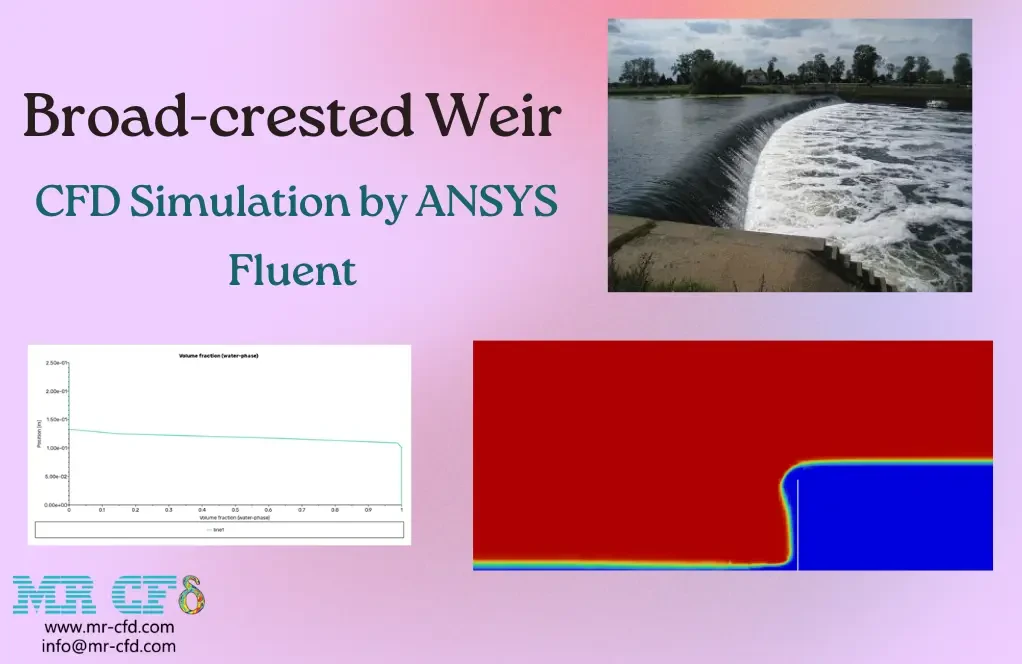
This project involves the simulation of a broad-crested weir using ANSYS Fluent to analyze fluid dynamics parameters. The primary goals are to assess the flow rate, drag force, and water level at various sections of the weir and compare these with experimental results. The geometry is created in SpaceClaim and meshed in ANSYS Meshing, resulting in a structured mesh with 1,222,021 elements for improved accuracy. The CFD simulation employs a pressure-based solver and a multiphase VOF model to address the incompressibility of fluids, with air as the primary phase and water as the secondary.
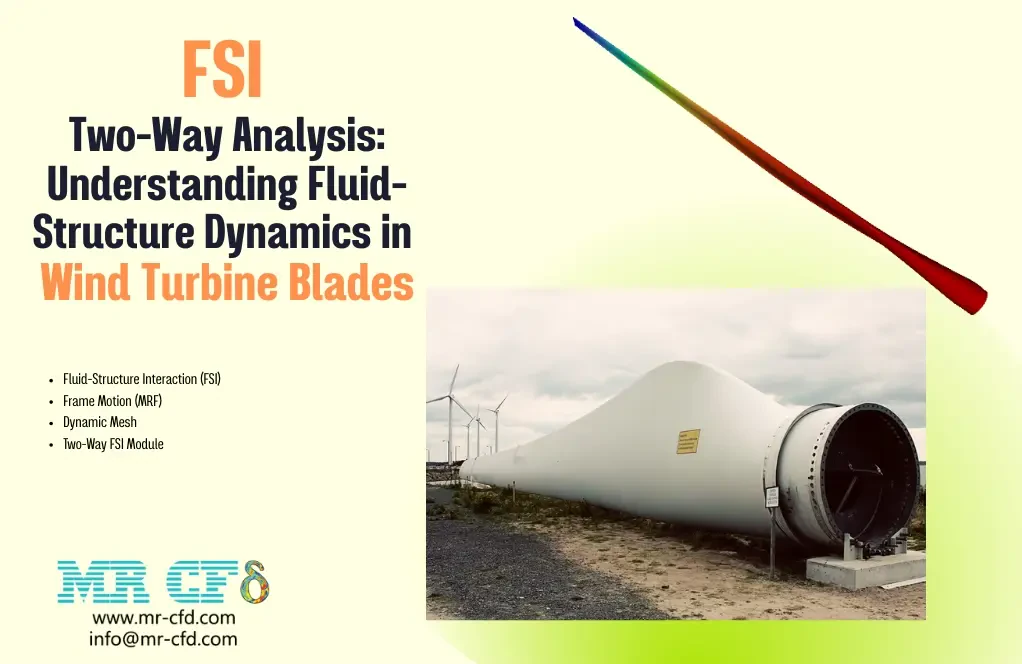
FSI Two-Way Analysis: Understanding Fluid-Structure Dynamics in Wind Turbine Blades
Intermediate, Advanced
Price: $270
This project focuses on the two-way Fluid-Structure Interaction (FSI) simulation of wind turbine blades to analyze their performance under specified conditions. Utilizing a dynamic mesh and advanced computational techniques, the study aims to evaluate key parameters such as torque, maximum stress, and total deformation. By modifying the geometry in ANSYS Spaceclaim and conducting the simulation with 990,399 cells, the project demonstrates how the blade’s structural integrity is affected by fluid flow and mechanical forces. The results, including stress distribution and displacement, provide insights into optimizing wind turbine design for improved efficiency and durability.
Price: $220
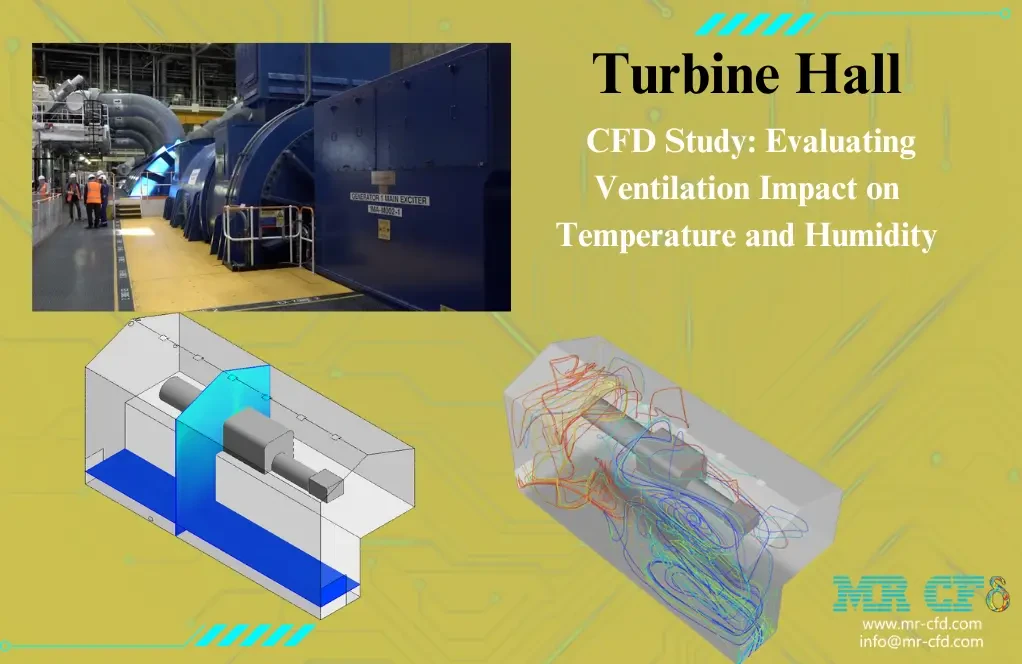
This project involves the simulation and analysis of the ventilation system within a turbine hall located in Hong Kong. Using a pressure-based CFD solver, the study examines the thermal conditions, including temperature variations and relative humidity during summer. The fluid domain, modeled as a mixture of nitrogen, water vapor, and oxygen, includes six exhaust fans strategically placed on the roof. The study explores four scenarios to assess different ventilation strategies, highlighting the importance of open doors during unit onloading to maintain a safer working environment. The findings contribute to optimizing the thermal management strategies and ensuring worker safety by maintaining acceptable temperature and humidity levels.
Twin Screw Extruder CFD Simulation, Using DEM and Dynamic Mesh
Intermediate, Advanced
Price: $108
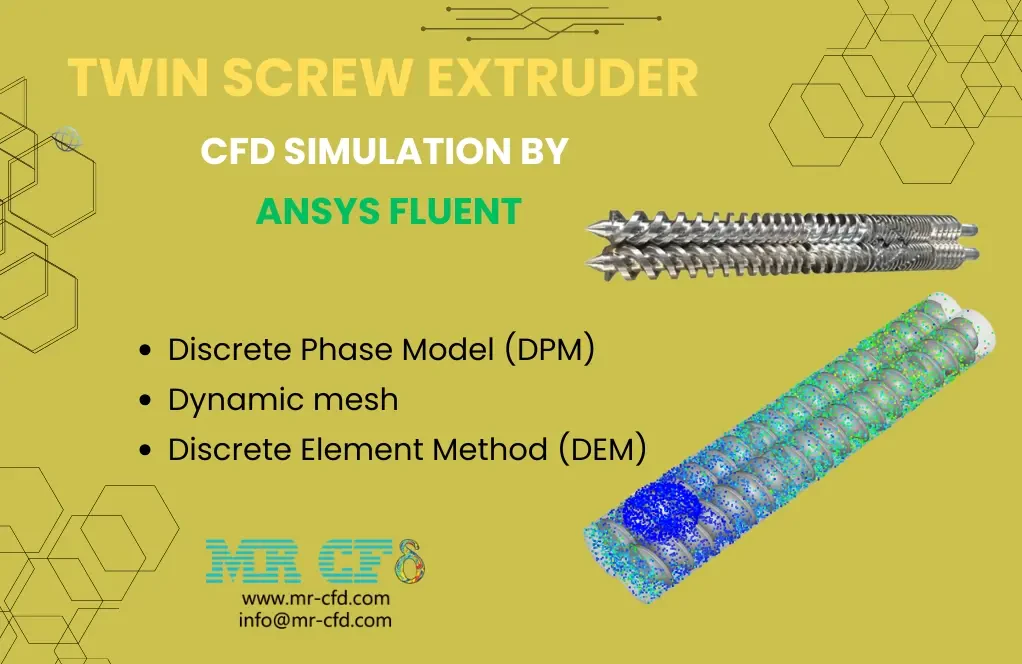
In this project, a twin screw extruder is simulated using ANSYS Fluent to analyze the interaction of water and particles within the system. The flow rate of particles is nine times that of the continuous phase, and both the interactions within the particle phase and with the continuous phase are considered using a 4-way DEM module. The geometry is designed in ANSYS SpaceClaim, and an unstructured mesh is generated in ANSYS Meshing with dynamic adjustments at each time step. The k-epsilon turbulence model and DPM model are employed along with the DEM module to simulate interactions. This complex simulation, involving dynamic meshing and high computational demands, reveals insights into particle tracking and residence time as the extruder operates at 300 rpm with a 60-degree rotation scope.

Radiant Solar Collector Applying PCM: Numerical Analysis and Heat Transfer CFD Simulation by ANSYS Fluent
Intermediate, Advanced
Price: $120
In this project, the numerical investigation of a radiant solar collector is conducted utilizing ANSYS SpaceClaim software, inspired by advanced modeling techniques. The 3D geometry is meticulously crafted and meshed with 647,500 elements, emphasizing an unstructured grid and refinement near the tubes to enhance simulation accuracy. The RNG K-epsilon turbulence model serves as the foundation for simulating the flow field, while the solidification and melting module addresses the PCM zone characteristics. Momentum, turbulence, and energy equations are tackled using the SIMPLE algorithm with second-order upwind discretization for precision. The simulation focuses on fluid dynamics and heat transfer, crucial for understanding the collector's performance under variable environmental conditions, despite the exclusion of radiation effects.